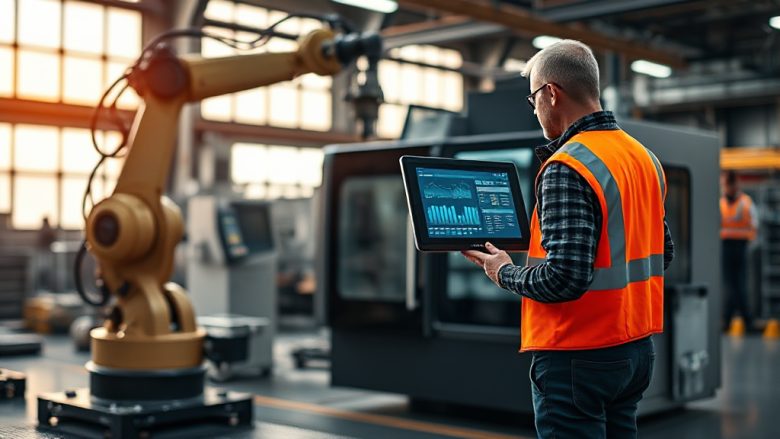
Walk into any UK factory and ask about Industry 4.0. You’ll get one of two reactions. Either a weary sigh about another buzzword cooked up by consultants, or a genuine question about where to even start. Both are fair. The term has been floating around for over a decade, yet for most small and mid-sized manufacturers, the gap between the conference slides and the shop floor is still wide.
This complete guide to Industry 4.0 in the UK is written for the operations director who keeps hearing the phrase and wants a straight answer. What is it, what does it actually mean for a business running CNC machines in Sheffield or a food packer in Norfolk, and what does sensible adoption look like when you don’t have a data science team on the payroll?
What Industry 4.0 Actually Means in Plain English
Strip away the jargon and Industry 4.0 is about connecting the physical side of manufacturing to digital systems so decisions get made with better information. That’s it. The first industrial revolution was steam, the second was electricity and mass production, the third was computers and automation. The fourth is the layer that ties all of that together: machines that report their own condition, systems that talk to each other, and data that flows from the shop floor to the finance office without someone retyping it into a spreadsheet.
The practical difference is feedback speed. In a traditional setup, a machine might run slightly out of tolerance for a week before anyone notices the scrap rate creeping up. With connected systems, that drift shows up in hours. A maintenance issue gets flagged before it becomes a breakdown. A supplier’s late delivery triggers a reschedule automatically rather than a phone call three days later.
Industry 4.0 isn’t a single product you buy or a switch you flip. It’s a direction of travel, and most UK manufacturers are somewhere along it already without calling it that. If you’ve fitted a smart energy meter or moved your job tracking onto a tablet, you’ve started.
Why the UK Context Matters More Than the Global Hype
The UK manufacturing base looks different from Germany’s or China’s. It’s smaller, more specialised, and dominated by SMEs. Roughly nine in ten manufacturers here employ fewer than 50 people. That shapes everything about how Industry 4.0 gets adopted.
Large automotive plants in the Midlands can justify seven-figure digital transformation programmes. A 30-person precision engineering firm cannot, and shouldn’t try. The good news is that the entry points have got cheaper. Sensors cost less than a decent lunch. Cloud storage is a monthly subscription rather than a capital project. The barrier now is rarely money; it’s knowing which problem to solve first.
There’s also a skills angle that gets underplayed. The UK has a well-documented shortage of engineers comfortable in both a machine shop and a Python script. That means adoption often leans on external partners or on upskilling existing staff rather than hiring specialists. Both routes work, but they need planning.
Government support has come and gone in waves, from Made Smarter pilots in certain regions to various innovation funding pots. The pattern is that help exists but is patchy and often underused because smaller firms don’t have the time to chase it. Worth a look, but don’t build your strategy around a grant that might not materialise.
The Core Technologies Behind Industry 4.0
You’ll see long lists of technologies in most write-ups. Here’s what actually matters in a UK manufacturing context, in roughly the order most firms encounter them.
Industrial IoT sensors. Small devices that measure temperature, vibration, pressure, current draw, or cycle counts and send that data somewhere useful. This is the foundation. Without data, nothing else works.
Machine connectivity and protocols. Getting older machines to talk to modern systems is often the hardest technical bit. Many UK shops run equipment from the 1990s alongside brand-new kit. Gateways and protocol converters bridge that gap, though it’s rarely plug-and-play.
Cloud and edge computing. Cloud platforms store and analyse data cheaply. Edge computing processes it locally where latency matters, like on a high-speed production line where a split-second delay causes problems.
Data analytics and dashboards. The layer that turns raw readings into something a shift supervisor can act on. Simple visual dashboards beat complex reports almost every time.
Automation and robotics. Collaborative robots, or cobots, have made automation accessible to smaller firms because they’re safer to work alongside people and don’t need caging. Still a capital decision, but less daunting than it was.
Digital twins. A virtual replica of a process or machine used for simulation. Powerful but usually a later-stage investment once you already have good data.
Additive manufacturing and AI. Both have real applications, particularly in prototyping and quality inspection, but they’re specific tools rather than universal starting points.
What You Stand to Gain, and What It Really Costs
The benefits are real but they arrive in a particular order. Early wins tend to be visibility: you finally know what’s actually happening on the floor. Then come efficiency gains, usually 5 to 15 percent in areas like changeover time, scrap reduction, or energy use. Then, if you keep going, you get the ability to predict problems rather than react to them.
Downtime reduction is often the biggest single prize. Unplanned stoppages are expensive, and even a modest improvement in early warning pays back a sensor project quickly.
The challenges are equally real. Integration with legacy equipment can swallow more time than expected. Data quality is a persistent headache; sensors drift, tags get mislabelled, and dashboards end up showing nonsense if nobody owns the data. Cybersecurity moves from an IT concern to a production risk once your machines are online. And there’s the human side: staff who feel monitored rather than supported will quietly resist, no matter how good the technology is.
Costs vary enormously, but a realistic first project for an SME might sit in the low thousands rather than the tens of thousands, provided you pick a narrow, well-defined problem.
A Phased Roadmap for UK SMEs
Don’t attempt a big-bang transformation. The firms that succeed tend to move in stages, proving value at each one before asking for more budget.
Stage one: pick one painful problem. Not the most exciting opportunity, the most annoying one. Excessive scrap on a particular line, or repeated breakdowns on a critical machine. Define what success looks like in numbers before you buy anything.
Stage two: instrument and observe. Fit sensors, start logging data, and watch for a few weeks. Resist the urge to automate anything yet. You’re establishing a baseline and learning what normal looks like.
Stage three: build a simple view. Turn that data into one dashboard that a supervisor checks each morning. If it doesn’t change behaviour, it’s not working.
Stage four: act and automate. Once you trust the data, use it to trigger alerts, adjust schedules, or feed a cobot. This is where the payback usually shows up.
Stage five: scale and connect. Extend the approach to other machines or lines, and start joining systems together so information flows across the business rather than sitting in silos.
Throughout, keep a named owner for the project. Digital initiatives without a clear internal champion tend to stall the moment the first operational crisis hits.
Where UK Manufacturing Is Heading Next
The direction of travel is toward tighter integration between shop floor and business systems, with energy monitoring becoming a standard part of the picture as costs and reporting obligations rise. AI is moving from novelty to practical tool, particularly in visual quality inspection where it can catch defects a human eye misses on a fast line.
Supply chain resilience, sharpened by recent years of disruption, is pushing more firms to share data with key suppliers and customers. That’s a bigger cultural shift than a technical one.
The firms that will do well aren’t necessarily the ones with the fanciest technology. They’re the ones that got comfortable making decisions from data, starting small, and treating digital adoption as an ongoing habit rather than a one-off project.
Frequently Asked Questions
Is Industry 4.0 only for large manufacturers?
No. The tools have become cheap enough for small firms, and SMEs often see faster payback because they can change processes quickly without layers of approval. The key is scoping a narrow first project rather than attempting a broad transformation.
Do I need to replace my older machines?
Usually not. Retrofit sensors and protocol gateways can bring decades-old equipment into a connected system at a fraction of replacement cost. It takes more integration effort, but it’s often the sensible route.
How much does a first Industry 4.0 project cost?
It varies widely, but a focused pilot monitoring one machine or line can often be done for a few thousand pounds. The bigger cost is usually staff time to plan it and interpret the results.
What’s the biggest mistake firms make?
Starting with technology instead of a problem. Buying sensors or software before defining what you want to improve leads to expensive experiments that never change how the business operates.